

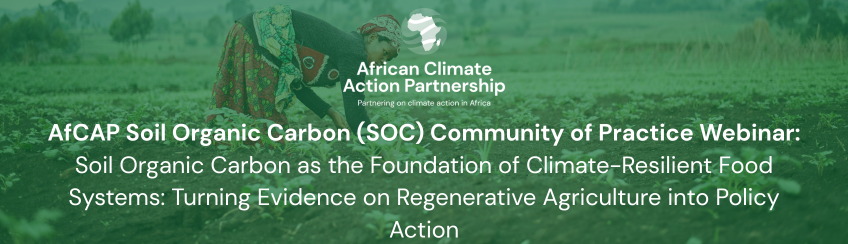
Soil Organic Carbon as the Foundation of Climate-Resilient Food Systems: Turning Evidence on Regenerative Agriculture into Policy Action
Soil organic carbon is increasingly recognised as a critical component of climate-resilient food systems. Although strong scientific evidence exists on sustainable agriculture and soil restoration, this knowledge is not always reflected in policies, investments, or land‑use planning. As a result, soil health remains undervalued in national food security and climate strategies.
The African Climate Action Partnership (AfCAP) launched its online webinar series, From Soil Health to Climate Action: Unlocking the Power of Soil Organic Carbon, through the Soil Organic Carbon Community of Practice (SOC-COP).
Held on the 9th of June 2026, the first session focused on “Soil Organic Carbon as the Foundation of Climate-Resilient Food Systems: Turning Evidence on Regenerative Agriculture into Policy Action”.
The webinar explored how evidence on soil health and regenerative agriculture can be translated into policy-relevant messages, measurable targets, and compelling investment cases. During the webinar, participants gained practical insights into its role in strengthening food security and learned why it should be more deliberately integrated into national policy frameworks. The session was organised in two parts: Why Soil Health Matters and From Evidence to Policy Action.
The webinar set the stage for continued dialogue on how soil organic carbon can inform more effective agricultural and climate policies. It also highlighted the value of collaboration among researchers, practitioners, and policymakers in advancing sustainable food systems.
The session was moderated by Nina Pretorius, Junior Project Manager for the African Climate Action Partnership, and the featured speakers including:
- Dr. Guillermo Peralta, FAO RECSOIL Global Soil Partnership, who presented on, Soil health as the foundation of food system resilience to ensure food security
- Dr. Leigh Ann Winowiecki, Coalition of Action 4 Soil Health (CA4SH), who presented on, Why soil and regenerative agriculture evidence often fails to shape policy and how this can lead to Co-creation between researchers and policymakers
Dr. Guillermo Peralta drew examples from the RECSOIL project to illustrate the importance of soil and agriculture in climate resilience and food systems. Building on this foundation, Dr. Leigh Ann Winowiecki examined the policy and financial dimensions of soil, reinforcing the need to connect scientific evidence with policy action and investment priorities.
Watch the recording to discover how evidence on soil health and regenerative agriculture can be translated into policy-relevant messages: