Policy

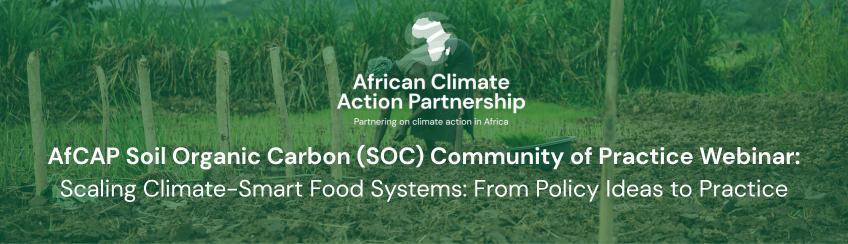
Scaling Climate-Smart Food Systems: From Policy Ideas to Practice 

Scaling Climate-Smart Food Systems: From Policy Ideas to Practice  848 244 Jamie

How do we move from promising policy ideas and pilot projects to practical, sustained action at scale? This was the central question explored in the third webinar of the series From Soil Health to Climate Action: Unlocking the Power of Soil Organic Carbon

On 28 July 2026, the African Climate Action Partnership (AfCAP) held the final session of the webinar series, titled Scaling Climate-Smart Food Systems: From Policy Ideas to Practice. It brought together insights on soil organic carbon, climate-smart agriculture and the practical systems needed to support wider adoption.  

The session examined why soil organic carbon and climate-smart agriculture matter for national food security, climate resilience and long-term agricultural transformation. Across Africa, many regenerative and climate-smart practices have shown strong potential, but adoption often remains limited because farmers face real barriers, including upfront costs, delayed benefits, limited advisory support, weak market access and insufficient risk-sharing mechanisms. 

A key message from the discussion was that scaling must be designed from the beginning. It is not enough to recognise soil health in policy documents; policies must be connected to delivery systems that farmers can actually use, including access to finance, inputs, training, climate information, extension services, monitoring tools and markets that reward sustainable production. 

The session was moderated by Nina Pretorious, Junior Project Manager for AfCAP, and featured Dr Ermias Betemariam, a land health scientist, at the World Agroforestry, specialising in land restoration, soil health, carbon dynamics and sustainable land management. His work links science, policy and practice to support resilient landscapes and food systems.  

The discussion reinforced that building soil organic carbon is not only a technical issue, but a systems challenge requiring stronger alignment between agriculture, environment, finance and planning sectors. 

Access the presentation below:

Watch the recording to discover how practical scaling pathways can align policy, finance and delivery with the everyday decisions farmers make on the ground here:

Agricultural Policy and Institutional Arrangements to enable Climate-Smart Rice

Agricultural Policy and Institutional Arrangements to enable Climate-Smart Rice 1600 900 Jamie

On the 12th of August 2025, the African Climate Action Partnership (AfCAP) hosted a webinar on “Agricultural Policy and Institutional Arrangements to enable Climate-Smart Rice”. This webinar explored how agricultural policy, and institutional arrangements can support the transition to climate-smart rice production. This session highlighted enabling policy frameworks and showcased national examples of innovative approaches and effective institutional coordination. The webinar also aided in identifying critical policy and institutional gaps that hinder the adoption of low-emission, climate-resilient rice practices.   

Dr. Jimmy Lamo, Senior Principal Research Officer & Rice Breeding Lead at National Agricultural Research Organization (NARO), opened the session on the Role of Research in Shaping Climate-Smart Policy. He emphasized that research provides the evidence needed to understand climate change, improve rice production, and reduce Greenhouse Gas (GHG) emissions, especially methane and nitrous oxide from rice farming practices. Dr. Lamo explained that key research areas include assessing climate impacts, developing resilient rice varieties through seed breeding, improving water and nutrient management, and promoting conservation agriculture such as perennial rice. He highlighted the importance of translating scientific findings into practical tools for policymakers and communities, supported by international collaboration and public awareness. Two case studies were shared: one on a high-yield, nutrient-efficient rice variety (WDR 7), and another on integrated pest management to reduce chemical use and promote crop rotation.  

Dr. Mary Mutembei, Head of the Rice Promotion Programme at the State Department for Agriculture, Ministry of Agriculture and Livestock Development in Kenya, opened up the second session on Enabling policy environments for scaling Climate-Smart Agriculture (CSA) for rice. This session emphasized the critical role of policies and institutions in scaling-up climate-smart rice cultivation. Despite extensive research and innovation, adoption remains low due to inconsistent policies, limited farmer awareness, weak extension services, and inadequate financial incentives.

Dr. Mutembei highlighted the need for coherent policy frameworks, stakeholder engagement, and gender equity, while stressing the importance of ministries, research bodies, and advisory services in driving adoption. Approaches like farmer training, public-private partnerships, and market-based incentives were recommended to boost uptake. Ultimately, she called for stronger collaboration, better funding, and integration of climate goals into agricultural support systems to overcome challenges and accelerate adoption. 

The final presentation was given by Rosemary Murori, Collaborative Research Scientist at International Rice Research Institute (IRRI), on the importance of building stakeholder alignment across rice systems. During her presentation Murori emphasized the importance of building strong stakeholder and institutional alignment to effectively scale climate-smart rice technologies. She highlighted that rice is a vital crop for global food security, grown by millions of farmers and consuming significant water resources, making climate-smart solutions essential. Murori stressed that no single institution can tackle these challenges due to limited resources and diverse mandates, calling for collaboration across research centers, governments, private sector, and scaling partners. She underscored the need for market intelligence to guide research and breeding efforts, ensuring technologies meet the needs of farmers, consumers, and markets. It was emphasized that deploying technologies is not just about availability, it’s about timing and coordination. Seeds must be accessible when farmers need them, and digital tools should be used to predict demand and guide seed producers. Monitoring and evaluation are also vital to track adoption and inform policy decisions.  Rosemary also highlighted the role of capacity building, showing how simple innovations, like upgrading seed dressing equipment, can dramatically improve efficiency and dissemination. Her message was clear: without strategic alignment and shared resources, even the best technologies risk remaining unused, limiting their potential to improve livelihoods and climate resilience. 

To view the recording of the webinar and presentations please use the links down below: 

Back to top